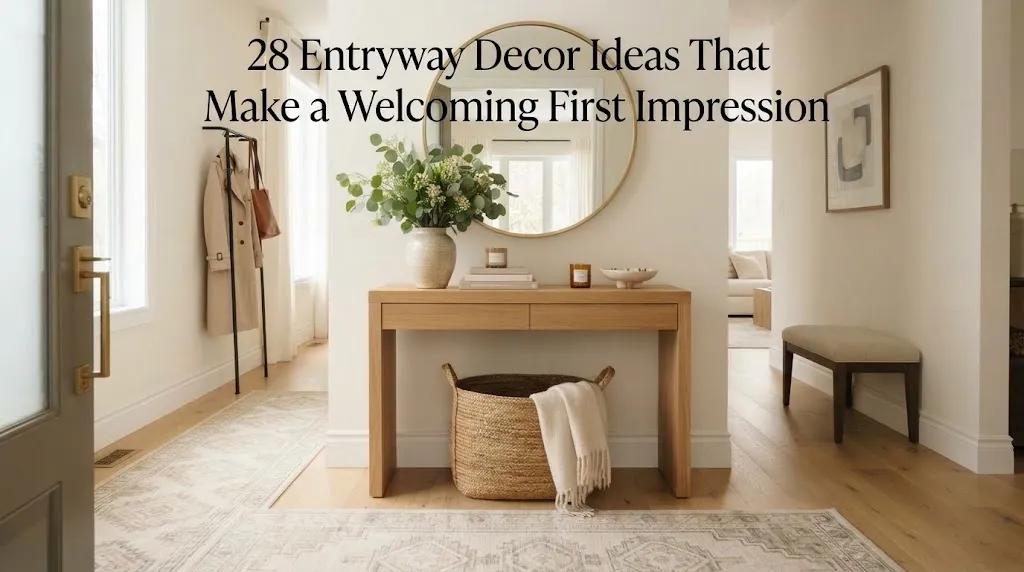
28 Entryway Decor Ideas That Make a Welcoming First Impression
Introduction
The entryway does a lot of quiet work. Shoes pile up there, mail lands there, and keys go missing there. It’s also the first thing guests see and the last thing you pass on the way out. The best entryway decor ideas handle both jobs at once, holding up to daily traffic while still looking intentional.
The 28 ideas below range from ten-minute styling changes and renter-friendly fixes to custom built-ins. That gives you options whether you have a narrow apartment landing, a suburban foyer, or a mudroom off the garage. Each one pairs a clear look with practical details like scale, placement, and materials, so you can borrow the principle even if you can’t copy the exact setup.
1. Layer a Slim Console With a Lamp, a Tray, and One Good Object
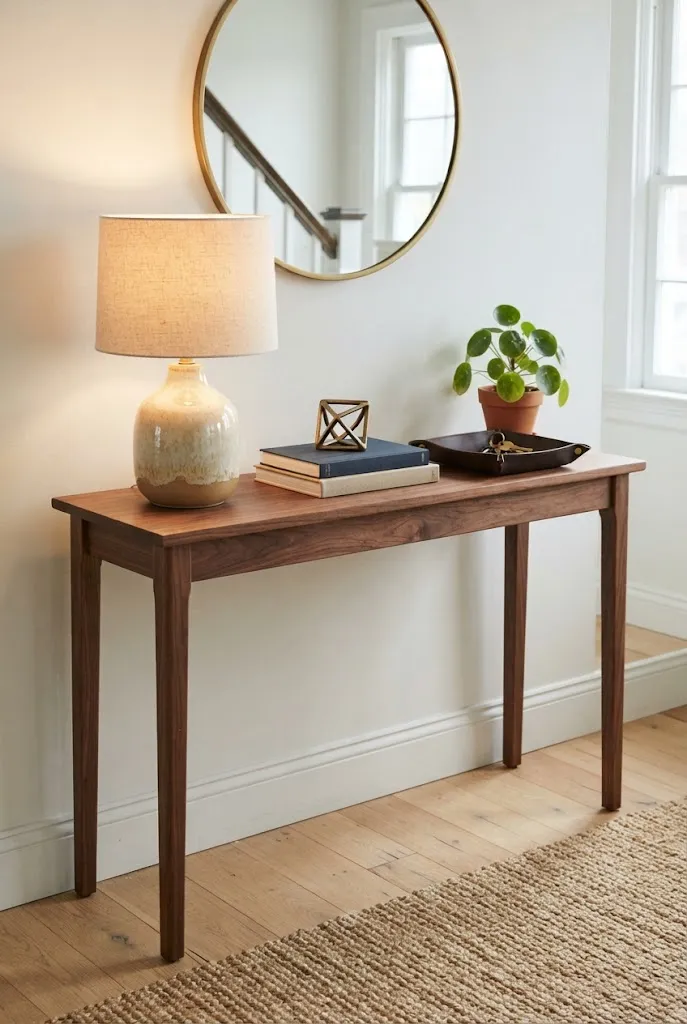
A console table works best when it’s styled in three heights: something tall (a lamp or a vase of branches), something mid-level (a small stack of books or a framed print), and something low (a tray for keys). That layering keeps the surface from looking flat and gives everything a clear job.
In tight spaces, look for a console with a depth of roughly 10 to 14 inches so it doesn’t crowd the walkway. A lamp does more than a ceiling fixture to make the entry feel welcoming after dark, because it throws warm light at a lower, softer level.
Quick Tip: Keep the lamp base narrow. A wide base eats up the one stretch of tabletop you actually need for keys and mail.
2. Hang a Shaker-Style Peg Rail Instead of a Hook Strip
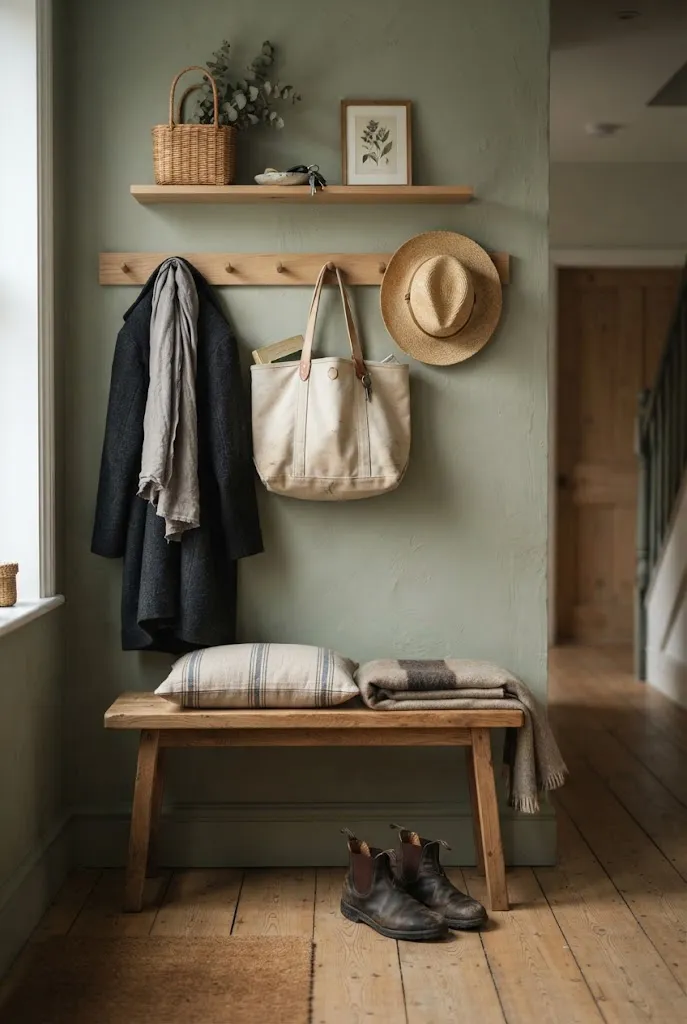
A wooden peg rail is one of the most useful ways to get coats and bags off the floor, and it looks like furniture rather than hardware. Painted the same color as the wall, it nearly disappears. In natural oak or walnut, it becomes a quiet focal point.
- Choose a rail with at least five or six pegs so there’s room for coats, totes, and a dog leash.
- Mount into wall studs where possible, since coats and bags add up to real weight.
- Hang a second, lower rail if kids will be using it. Pegs set somewhere around 45 to 48 inches off the floor are easier for small hands.
- Add a narrow shelf above the pegs for hats and a small basket.
Many versions are inexpensive, and a basic one can be installed in an afternoon.
3. Build a Bench With Hidden Cubbies Underneath
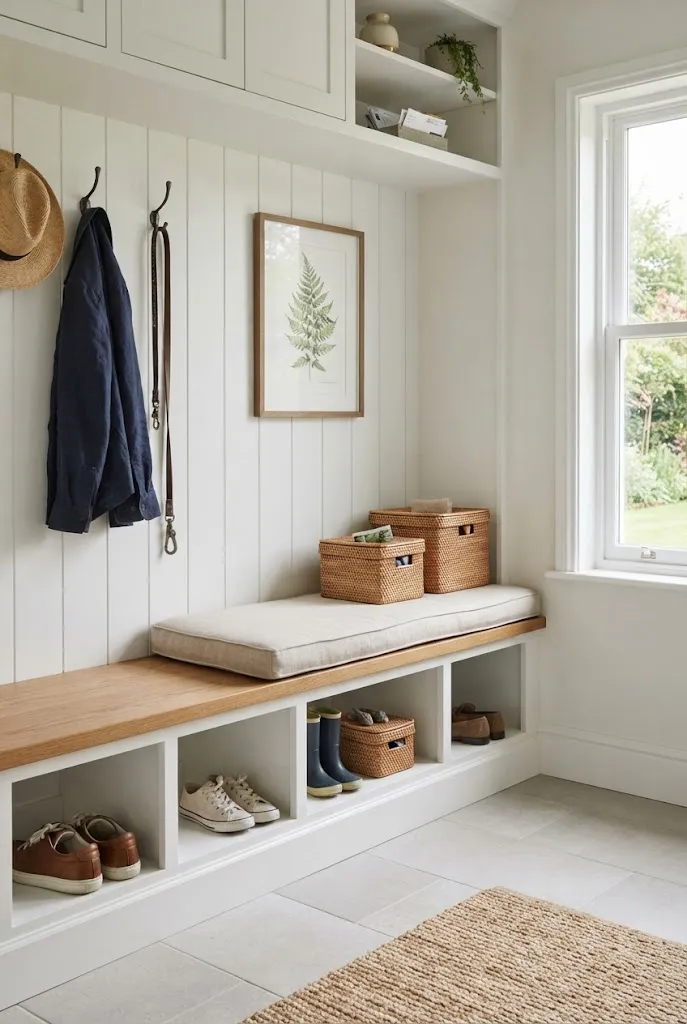
Best For: Families, anyone with a deep wall to work with
Investment: Moderate to premium, depending on custom versus ready-made
Visual Effect: A sit-down spot that also hides shoe clutter
A bench gives people a place to sit while putting on shoes, and cubbies or lidded storage underneath keep everything off the floor. A ready-made storage bench with a cushioned top is the accessible route. A custom built-in with painted cabinetry and a wood seat is the upgrade.
Size the bench to the wall rather than the other way around. One that stops a few inches short of a door swing or radiator will always feel better than one wedged in tight. A removable seat cushion in a washable fabric makes the whole thing easier to live with.
4. Hang an Oversized Round Mirror Above the Console
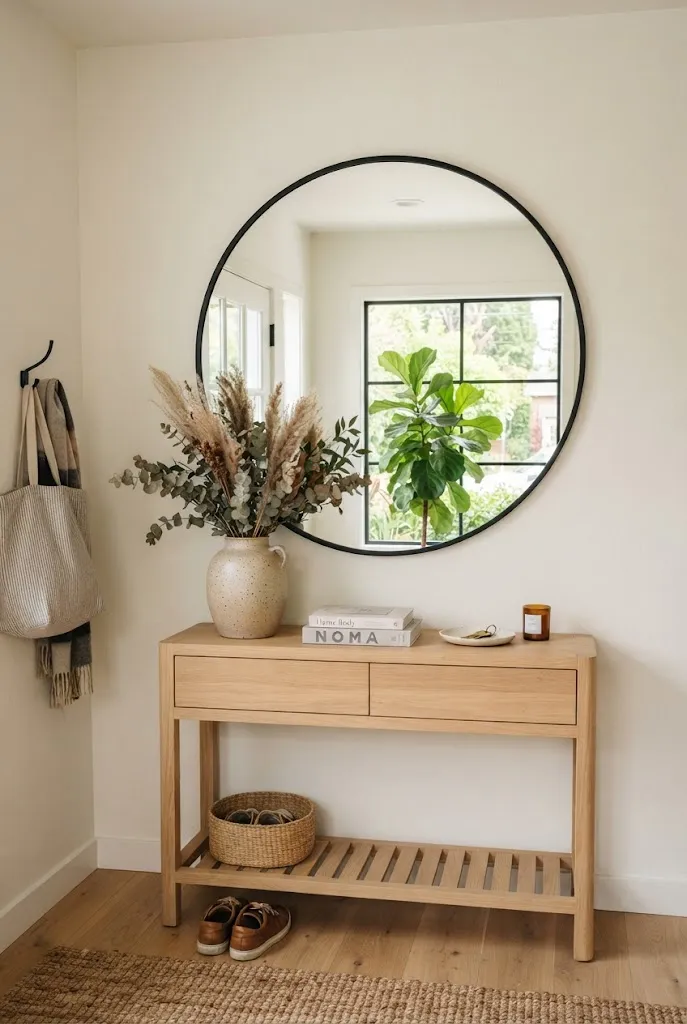
A large round mirror reflects light from the nearest window or door, which makes a small entry feel less boxed in. The curve also breaks up the rectangles of doors, frames, and furniture that usually dominate the space.
Common Mistake: Hanging the mirror too high so it only shows the ceiling.
Better Approach: Center it at roughly eye level, around 57 to 60 inches from the floor, with the bottom edge sitting several inches above the console. That way it actually works as a last-look mirror on the way out, and it still reads as one piece with the table below.
Look for a thin metal or wood frame if the entry is small. A thick, ornate frame can overwhelm a narrow wall.
5. Run a Washable Runner Down a Long Entry
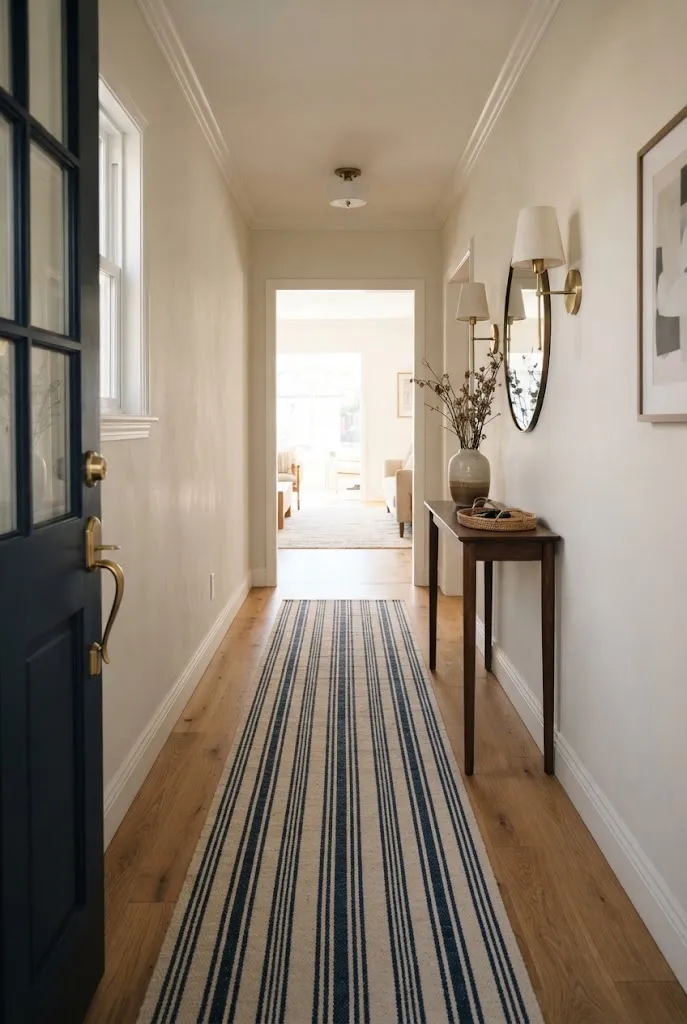
A runner defines the walking path, protects the floor from grit, and adds pattern or color without taking up wall space. Flat-weave and low-pile styles are the most practical because doors clear them easily and they’re simpler to shake out.
For wet or snowy climates, a polypropylene or other synthetic runner handles moisture better than natural jute, which tends to hold dampness. A rug pad underneath keeps the runner from sliding on hard floors, which matters most right at the door where people step in with wet shoes. Leave a few inches of bare floor on each side so the runner looks deliberate instead of squeezed in.
6. Paint the Inside of the Front Door a Deep, Saturated Color
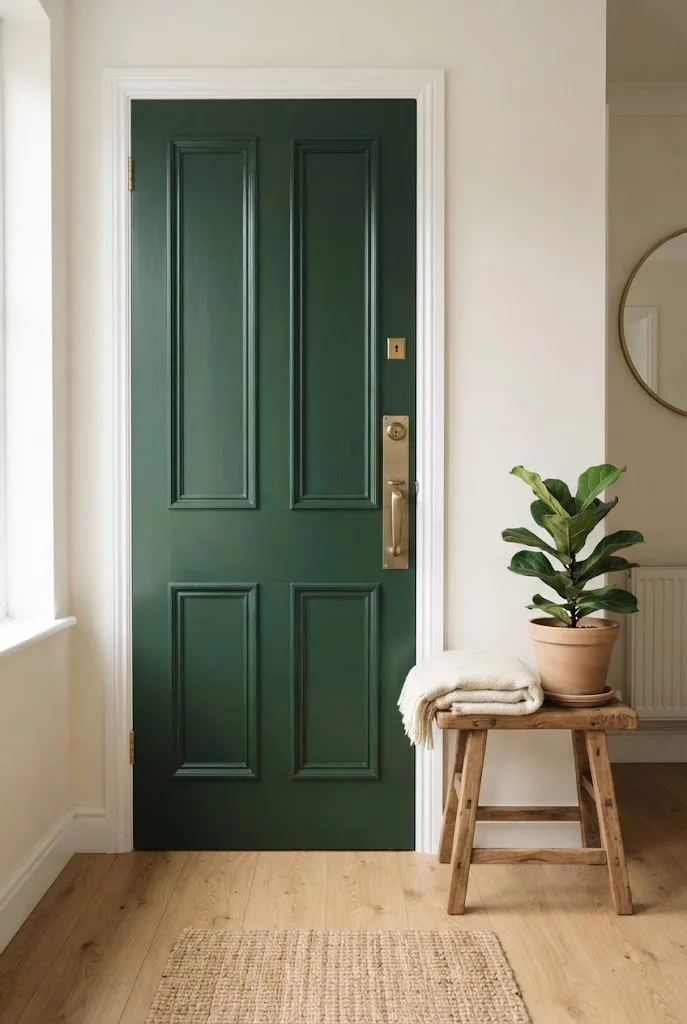
A painted door is among the lowest-cost changes you can make, and it works even in a cramped entry. Deep green, navy, charcoal, and warm terracotta all give the space a clear anchor. The door becomes the focal point instead of a blank slab.
- Wipe the door down and lightly sand any glossy areas.
- Prime if the existing finish is shiny or you’re making a big color jump.
- Tape off hardware, glass, and weatherstripping.
- Apply two thin coats of a durable enamel, letting each one dry fully.
Renters should check the lease first, since some require repainting before move-out.
7. Add Board-and-Batten Paneling to the Lower Wall
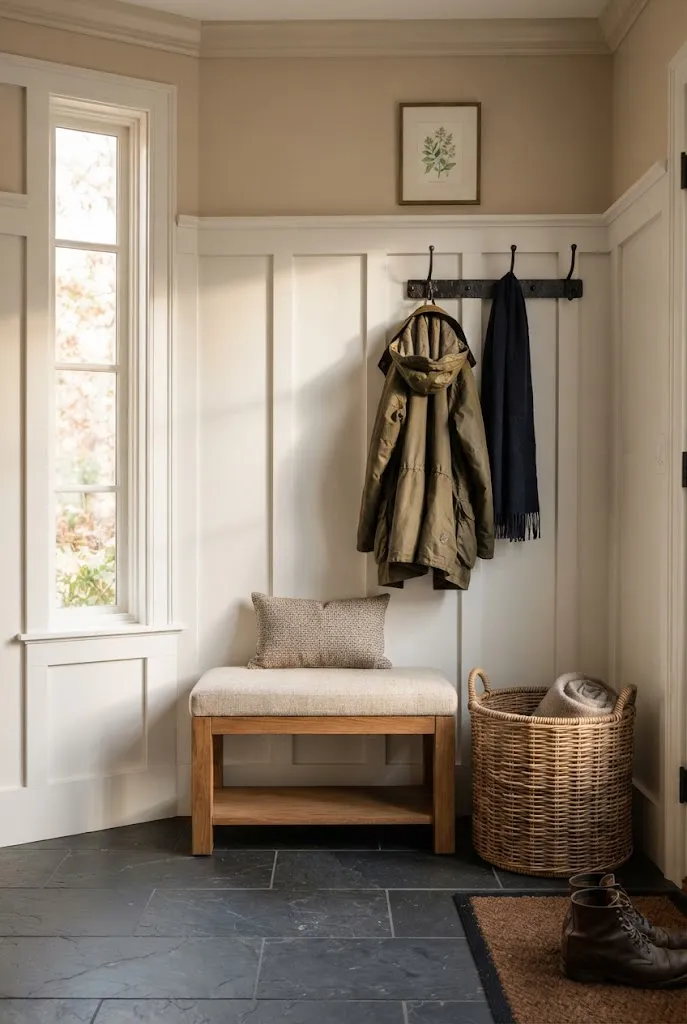
Board-and-batten adds structure to a flat wall, and it takes scuffs better than bare drywall, which is helpful behind a bench or coat hooks. The look is clean and simple, and it pairs well with farmhouse, traditional, and transitional interiors.
The DIY version uses MDF strips, a level, construction adhesive, and a small finish nailer. Caulk the seams and paint everything one color, ideally in a satin or semi-gloss finish that wipes clean. Pick a height that lines up with something real in the room, such as a window sill or the top of a door casing, so the paneling feels planned.
Do: Keep the batten spacing even and measure it out before nailing.
Don’t: Eyeball it. Uneven gaps show up immediately on a long, plain wall.
8. Use Peel-and-Stick Wallpaper on One Wall
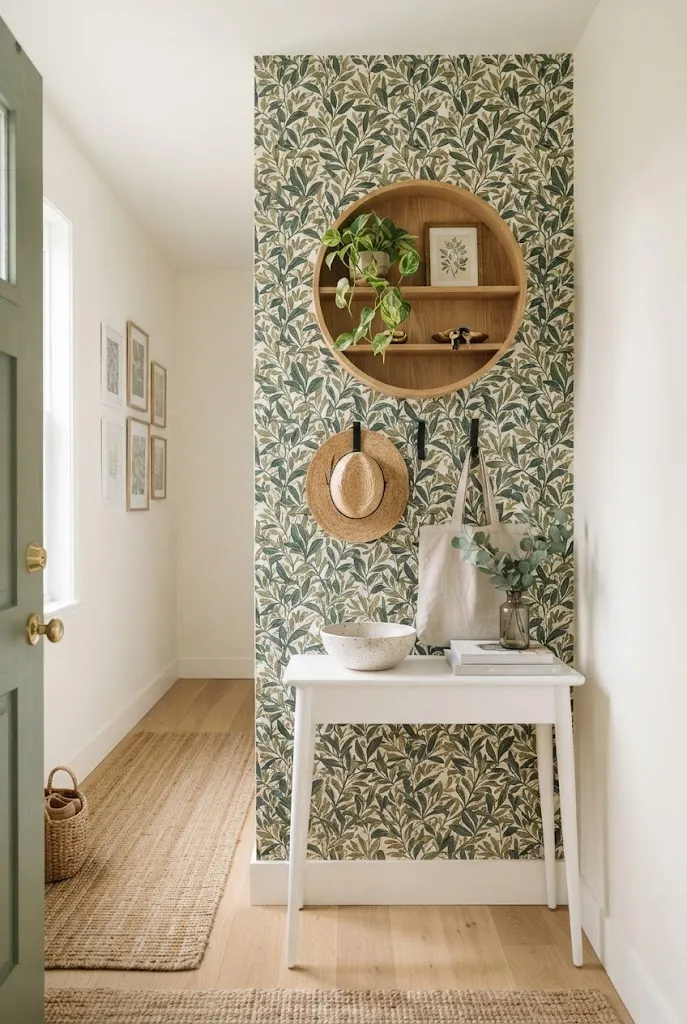
A small entry can handle a bolder pattern than most people expect, since you only spend a few seconds in it at a time. Peel-and-stick wallpaper is the renter-friendly way to try it. A botanical print, a small geometric, or a textured grasscloth look can all change the mood of the whole space.
Editor’s Note: Adhesion depends heavily on the wall. Heavily textured or freshly painted walls can cause bubbling or peeling, so test a small piece in a hidden corner and give it time before committing to the full wall. Smooth, well-cured painted surfaces tend to give the most reliable results.
9. Flank a Mirror With Plug-In Sconces
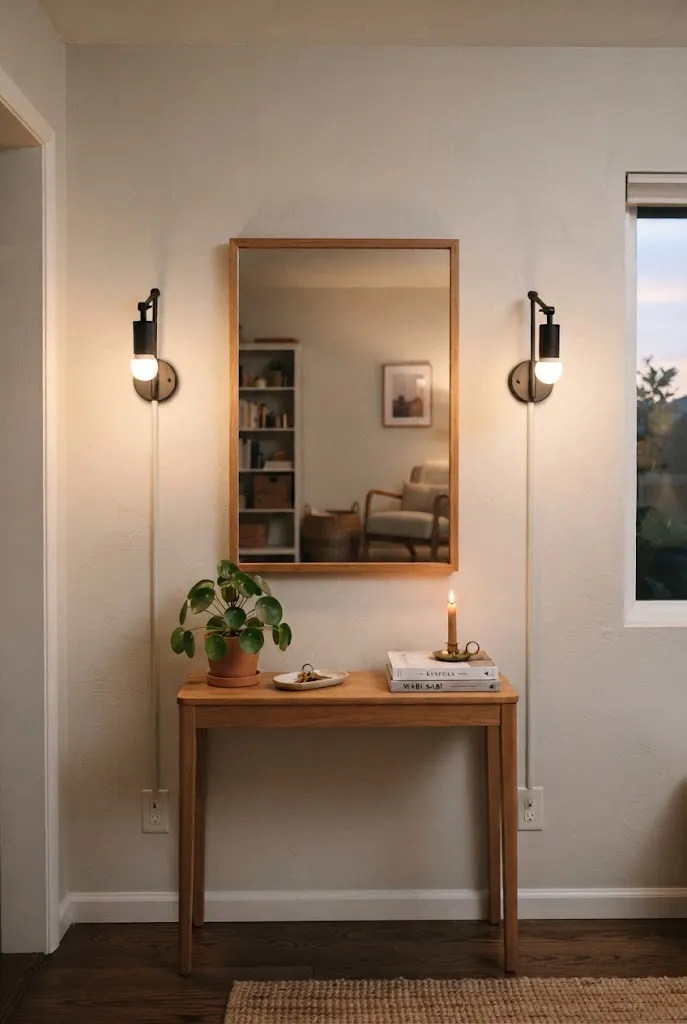
Wall sconces add layered lighting at face height, which is far more flattering than a single overhead fixture. Plug-in versions don’t require an electrician or any wall cutting, so they’re a good fit for rentals and older homes.
- Choose swing-arm or compact fixtures that don’t stick out into the walkway.
- Run the cords down inside a paintable cord cover in the same color as the wall.
- Use warm-white bulbs so the light feels inviting instead of clinical.
- Mount them a few inches out from each side of the mirror, at about shoulder height.
Hardwired sconces are the cleaner long-term solution if you’re already working with an electrician.
10. Corral Shoes in Woven Baskets and a Boot Tray
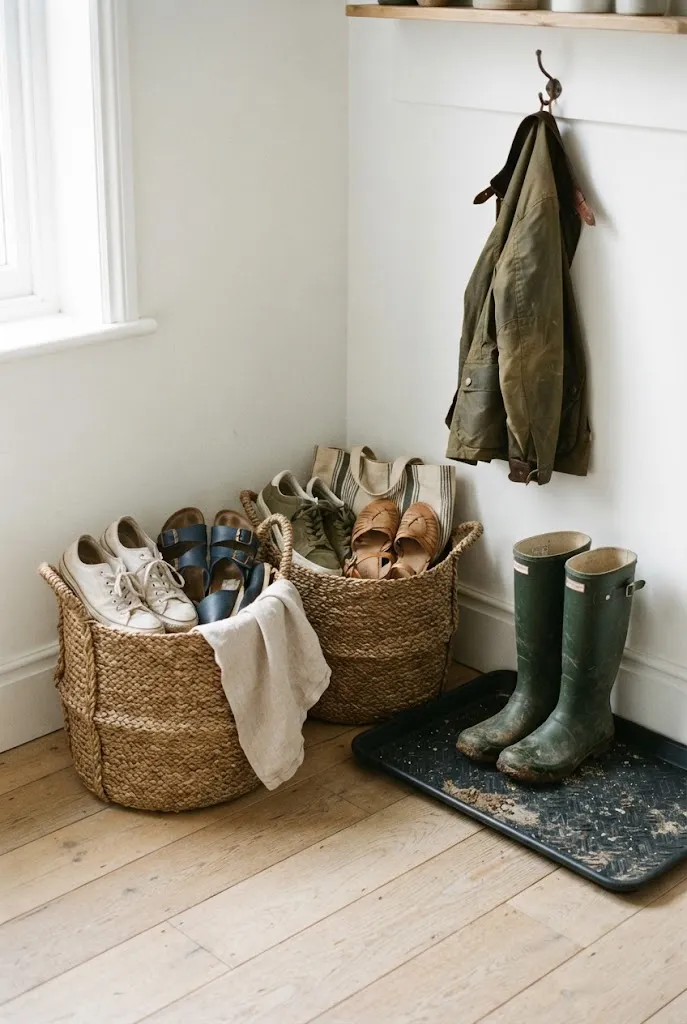
Open shoe piles are what make an otherwise styled entry look messy. A few lidless woven baskets give shoes a landing place that still looks warm and textural, and a rubber boot tray beneath them catches meltwater and mud.
Tips & Tricks
- Assign one basket per person so everyone knows where theirs goes.
- Choose baskets with sturdy sides, since flimsy ones slump once they’re loaded.
- Keep only the current season’s shoes at the door and store the rest elsewhere.
- Slip a washable liner or cloth into the basket if wet shoes will go in it.
11. Repurpose a Vintage Dresser or Chest as the Console
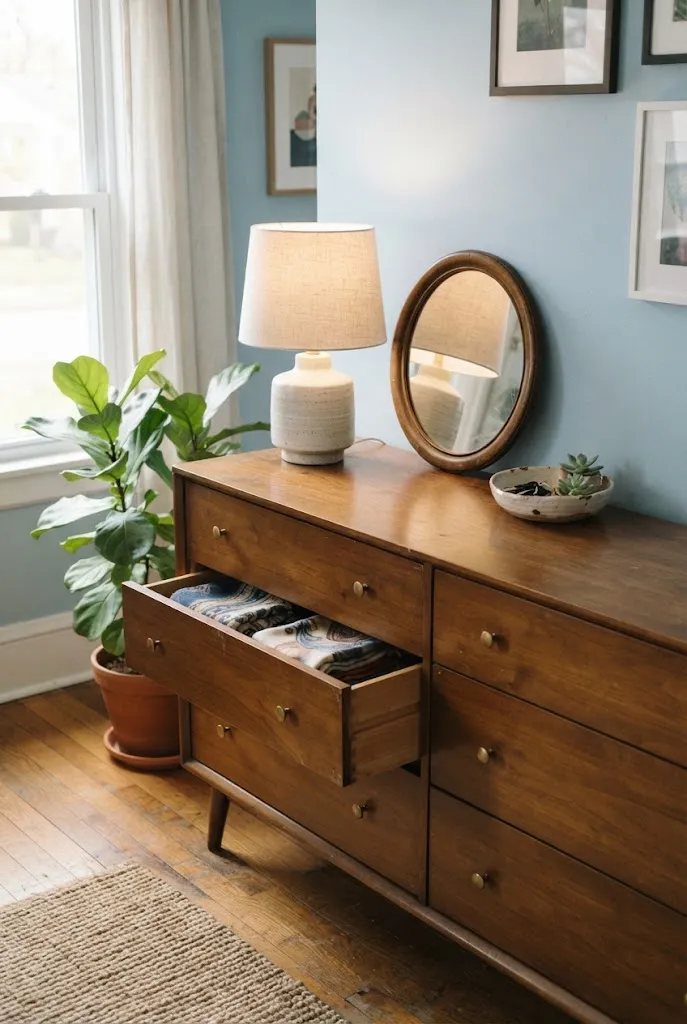
A secondhand dresser or low chest gives an entry real storage and instant character, often for less than a new console. Drawers hide gloves, scarves, dog supplies, and reusable bags, while the top acts as a styling surface.
Thrift stores, estate sales, and online marketplaces are all worth checking. If the finish is worn, a light sanding and a coat of paint or stain can bring it up to date. Swapping out dated hardware for simple brass or matte black pulls changes the look immediately. Add felt pads under the feet so it won’t scratch the floor.
12. Carve Out an Arched Niche With a Single Shelf
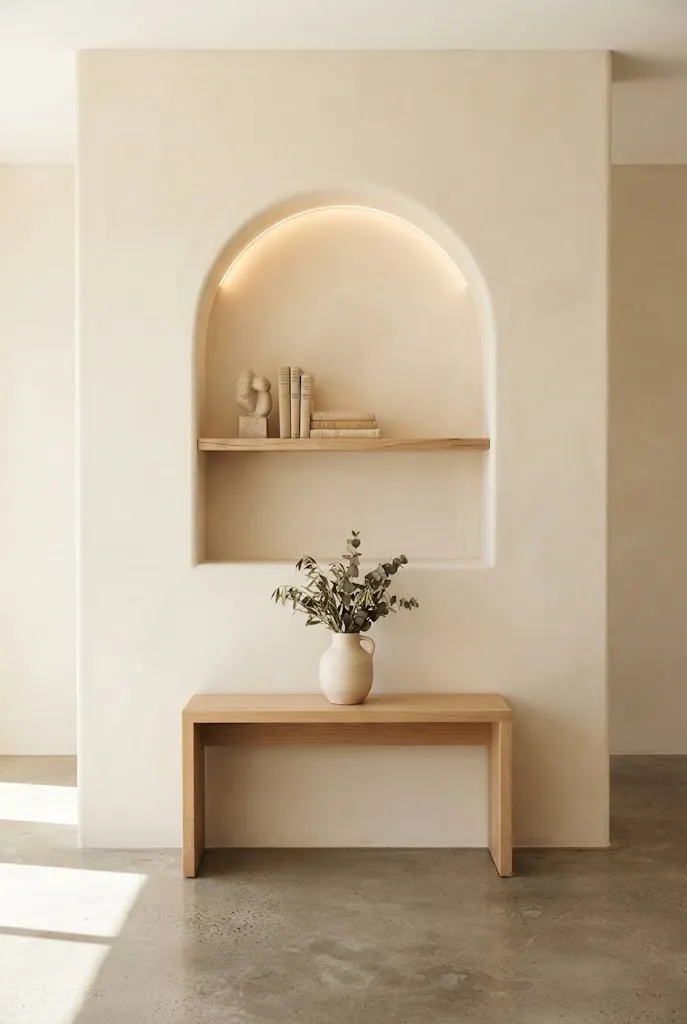
A recessed arch in the wall draws the eye and gives you a spot for a small sculpture, a vase, or a few books. It’s a custom architectural detail, so it falls on the premium side, and it works best when planned during a renovation where the wall cavity is accessible and free of wiring or plumbing.
For a simpler version, hang an arched mirror or an arch-shaped wall shelf. It borrows the same soft curve without cutting into drywall. The principle is what matters here: one curved shape in a room full of straight lines.
13. Fill a Narrow Hall With a Tight-Grid Gallery Wall
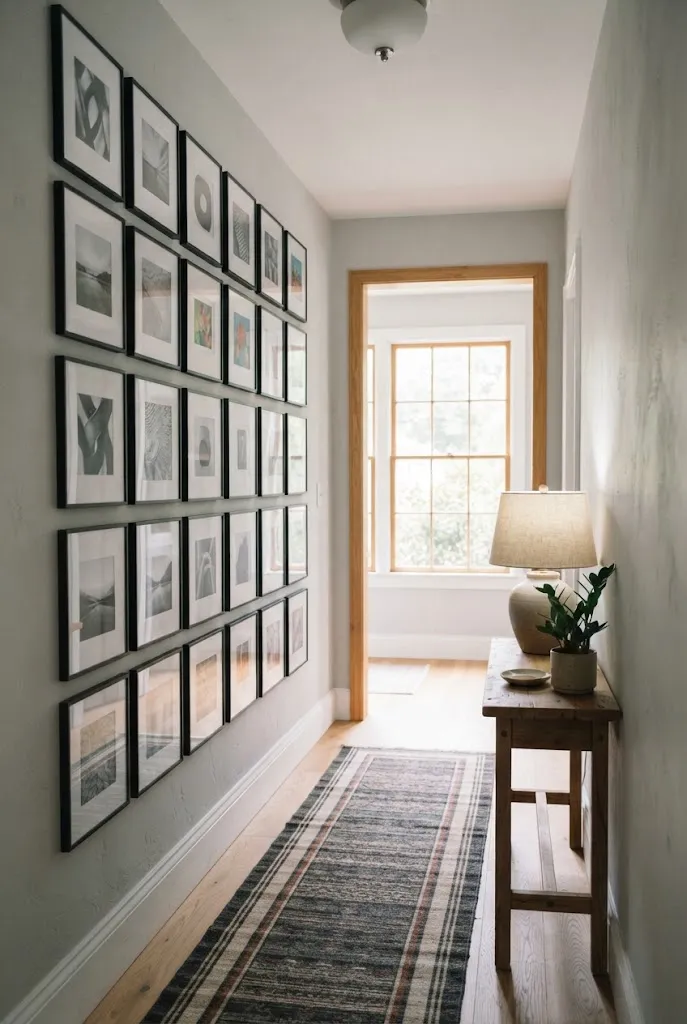
A gallery wall gives a long, plain entry real personality. Rather than a loose scatter of frames, a tighter grid keeps the effect calm and organized, especially in a narrow space where a messy arrangement would feel chaotic.
- Trace each frame on kraft paper and cut out templates.
- Tape the templates to the wall and adjust until the spacing feels right. About 2 inches between frames is a common starting point.
- Hang the center frame first, around eye level, then work outward.
Mix black-and-white photography with a few colored prints. Matching frames in one finish tie everything together.
14. Lean Art on a Picture Ledge Above the Bench
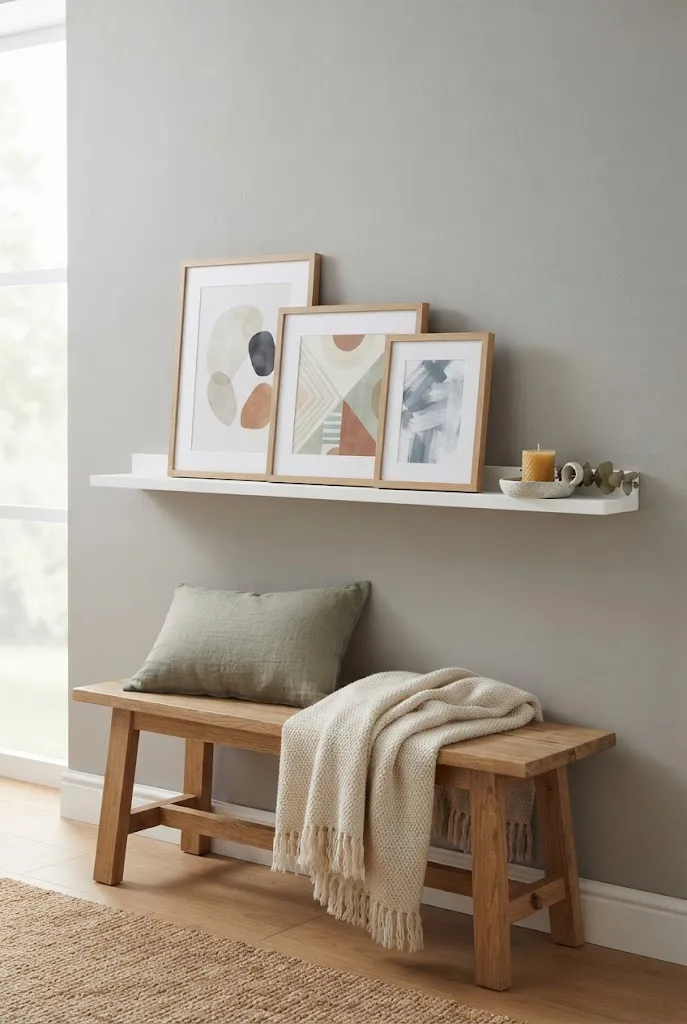
A picture ledge lets you swap artwork without patching nail holes, so it suits renters and anyone who likes to change things up. Lean two or three frames at different heights, slightly overlapping, and add a small object like a candle or a ceramic dish.
The layered, casual look pairs well with a bench or console below. It also lets you rotate seasonal prints, kids’ artwork, or travel photos in seconds. Choose a ledge that’s deep enough for the frames you plan to use, since shallow ones tip easily.
15. Anchor the Corner With One Tall Plant
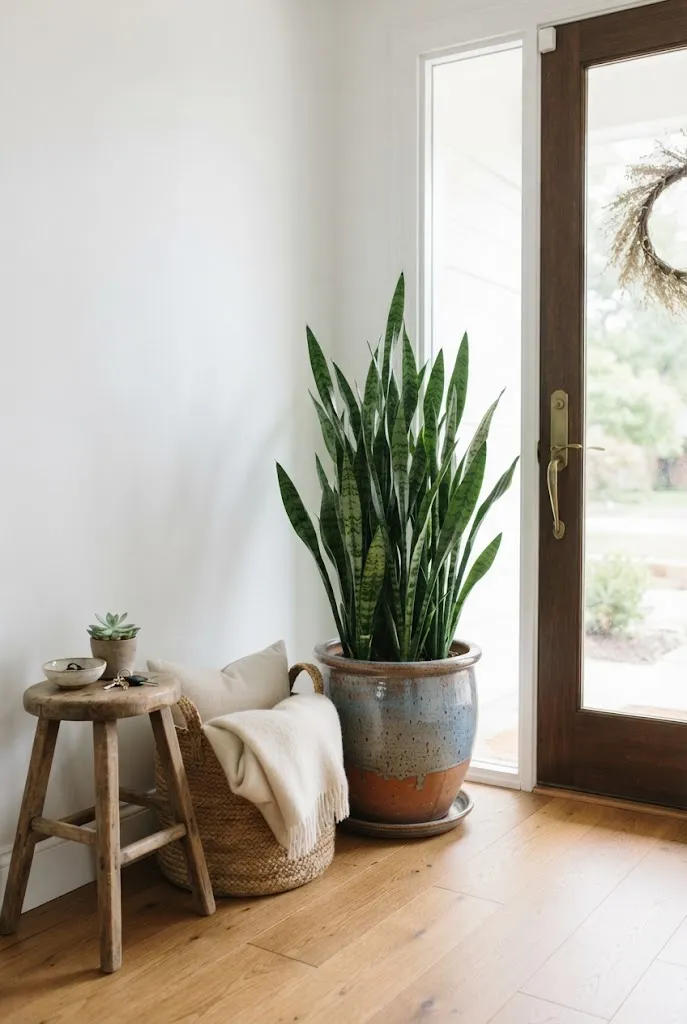
A single, tall plant brings height and life to an entry corner that otherwise goes empty. Pick something suited to the light you actually have. Snake plants and ZZ plants are often recommended for lower-light spots, while a fiddle-leaf fig or olive tree needs a much brighter window.
If natural light is poor or the space is a dark interior hall, a good-quality faux plant is a practical alternative. Either way, set the plant in a pot with a saucer or a hidden drainage tray to protect the floor. A woven basket or ceramic planter in a neutral tone keeps the look pulled together.
16. Swap the Builder-Grade Fixture for a Statement Pendant
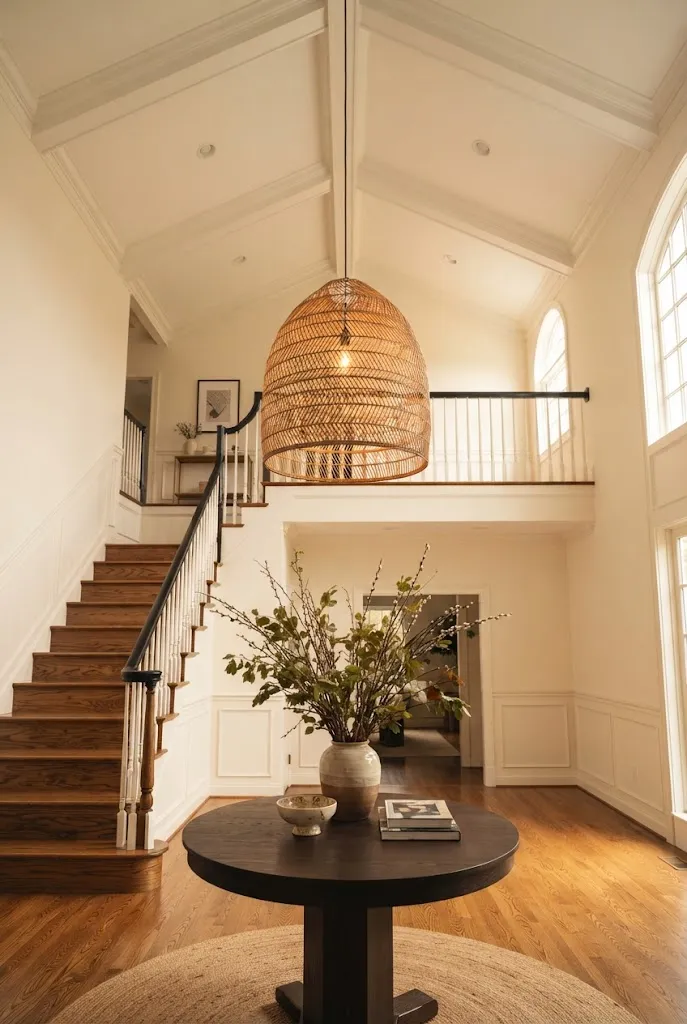
Many entries ship with a plain flush-mount light that does little more than keep people from tripping. Replacing it with a more considered fixture changes the whole feel of the space, especially in a two-story foyer where the light hangs in plain view.
| Option | Effect | Best Fit |
|---|---|---|
| Pendant | Strong focal point, more visual presence | Higher ceilings, open foyers |
| Semi-flush mount | Decorative without hanging low | Standard 8-foot ceilings |
| Plug-in sconces | Layered, no wiring needed | Rentals, older homes |
Replacing a hardwired fixture generally calls for a licensed electrician, so factor that into the budget. Whichever you choose, scale the fixture to the space. Too small looks lost, and too large crowds the room.
17. Convert a Mudroom Wall Into Individual Lockers
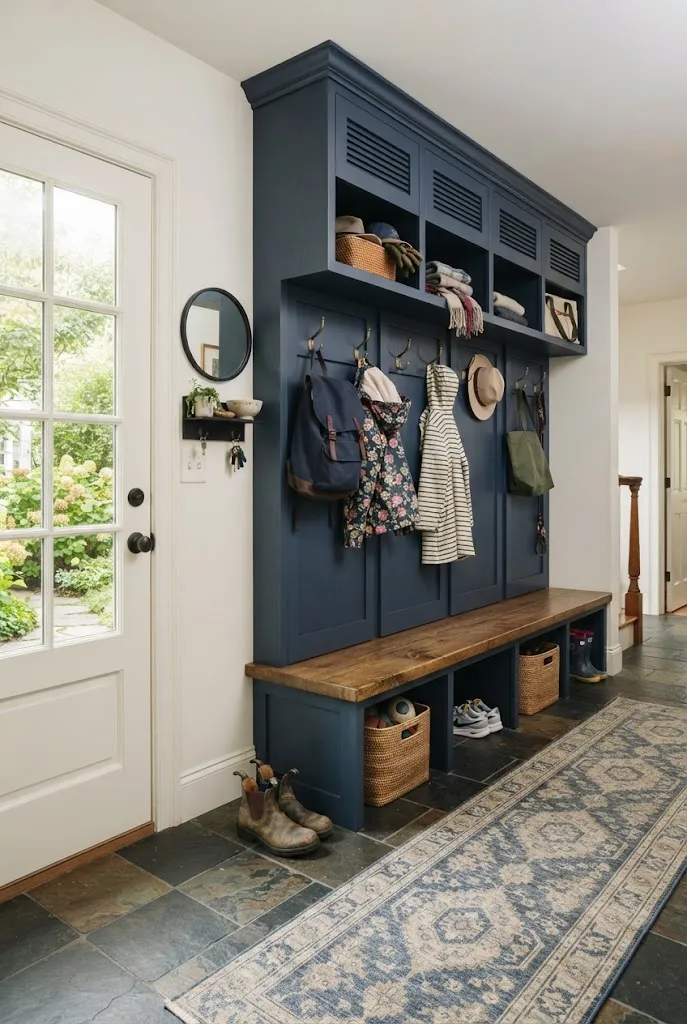
For busy households, lockers are the most organized version of an entry. Each person gets a hook zone, a shelf, and a spot for shoes or a bin, which cuts down on the daily search for backpacks and cleats.
Custom built-ins with painted cabinetry are the high-end route. Modular locker systems and ready-made cubby units offer a more attainable version. If the lockers will hold wet gear, include some ventilation, such as slatted panels or open backs, so coats and boots can dry. A bench running the length of the lockers makes the whole thing function as one unit.
18. Turn the Space Beneath the Stairs Into a Drop Zone
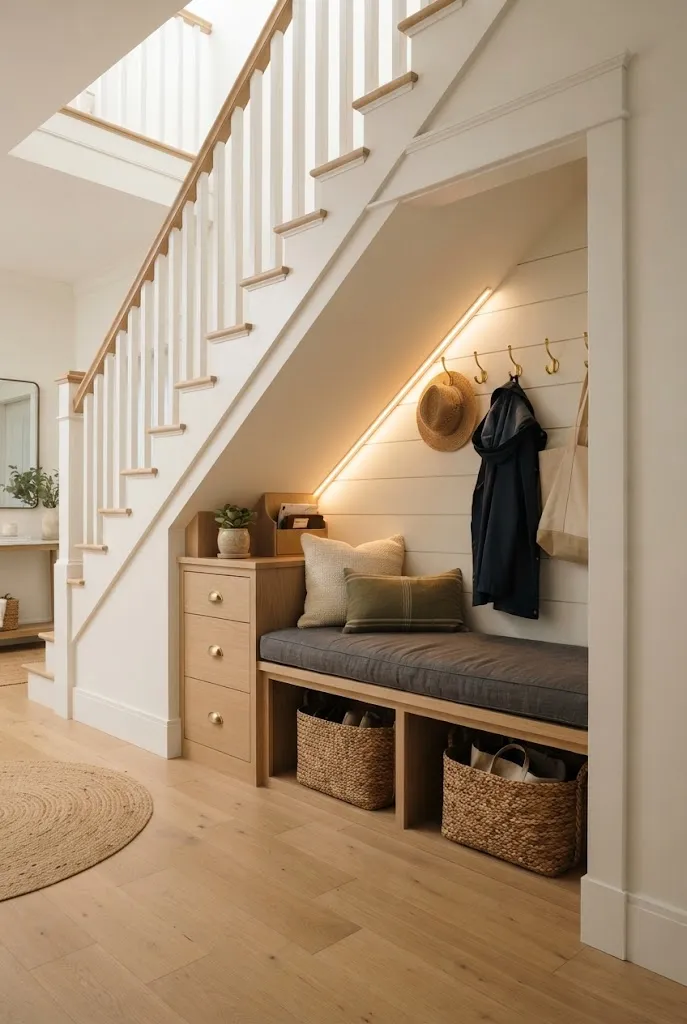
When the entry sits next to a staircase, the triangle of space below it is often wasted. A built-in bench, a row of hooks, and a set of drawers can turn it into a compact drop zone without taking any floor space from the room.
- Measure the clearance carefully. The ceiling slopes, so the tall end suits hooks and the low end suits drawers or cubbies.
- Add a light, such as a small LED strip, so the nook doesn’t feel like a cave.
- Keep the front edge clean and simple, since stairs already create a lot of visual movement.
This one is typically a custom carpentry project and sits at the premium end.
19. Use a Freestanding Coat Rack and Shoe Shelf When There’s No Closet
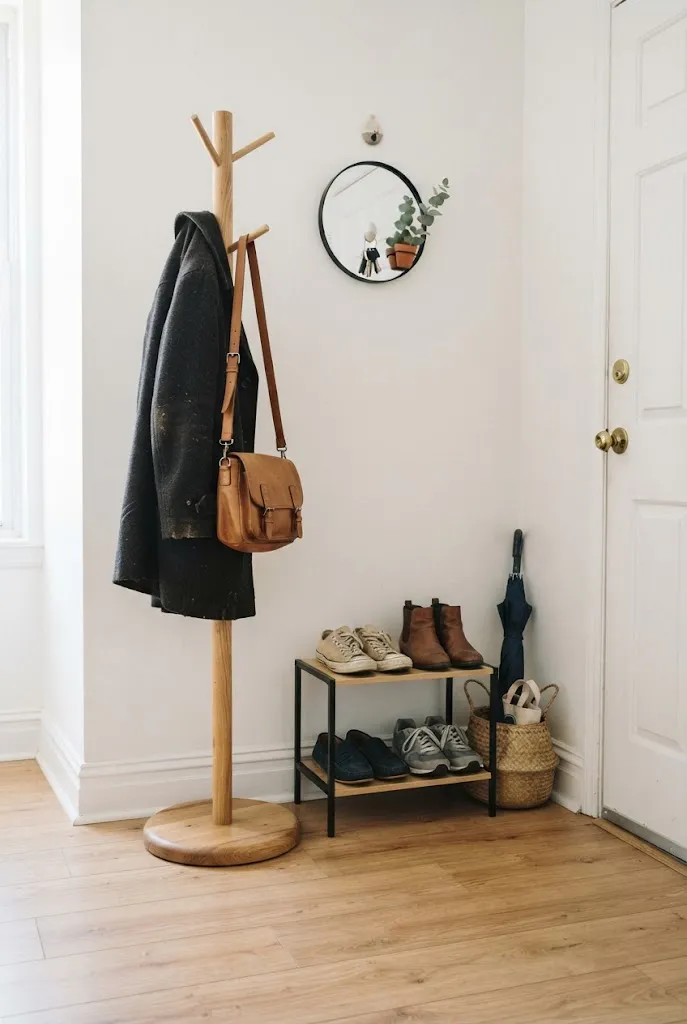
Many apartments have no entry closet at all. A freestanding coat rack paired with a slim shoe shelf creates a drop zone without any drilling.
Common Mistake: Hanging several heavy coats on a lightweight rack, which tips it over.
Better Approach: Choose a rack with a wide, weighted base, or anchor a tall one to the wall with an anti-tip strap. Place the heaviest coats on the lower hooks, and keep the top for scarves and light bags. A narrow shoe rack beside it holds everyday pairs, and a small basket on the floor covers umbrellas and dog gear.
20. Mount a Floating Shelf With Key Hooks
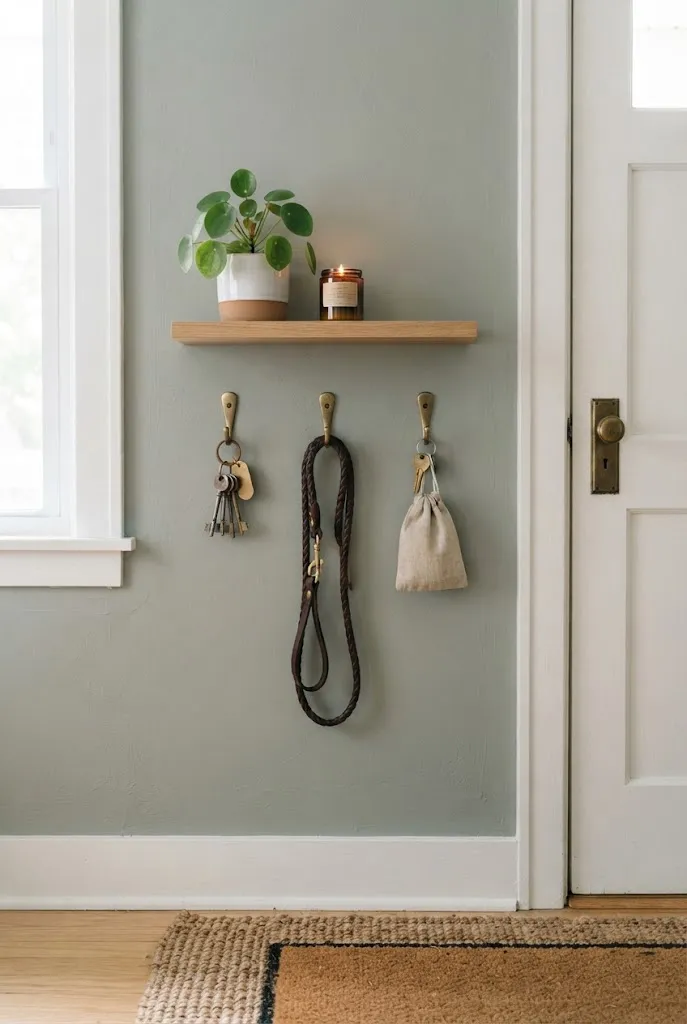
When the entry is more of a landing than a room, wall space is all you’ve got. A floating shelf with three or four hooks underneath handles keys, sunglasses, and a small plant or candle, all within about two feet of wall.
Look for a shelf around 6 to 8 inches deep so it stays slim in a tight space. Wood, matte black metal, and painted finishes all work, depending on the surrounding palette. Use proper wall anchors rated for the weight if you aren’t hitting a stud, and keep the objects on the shelf sparse so it doesn’t look cluttered.
21. Lay a Checkerboard Floor
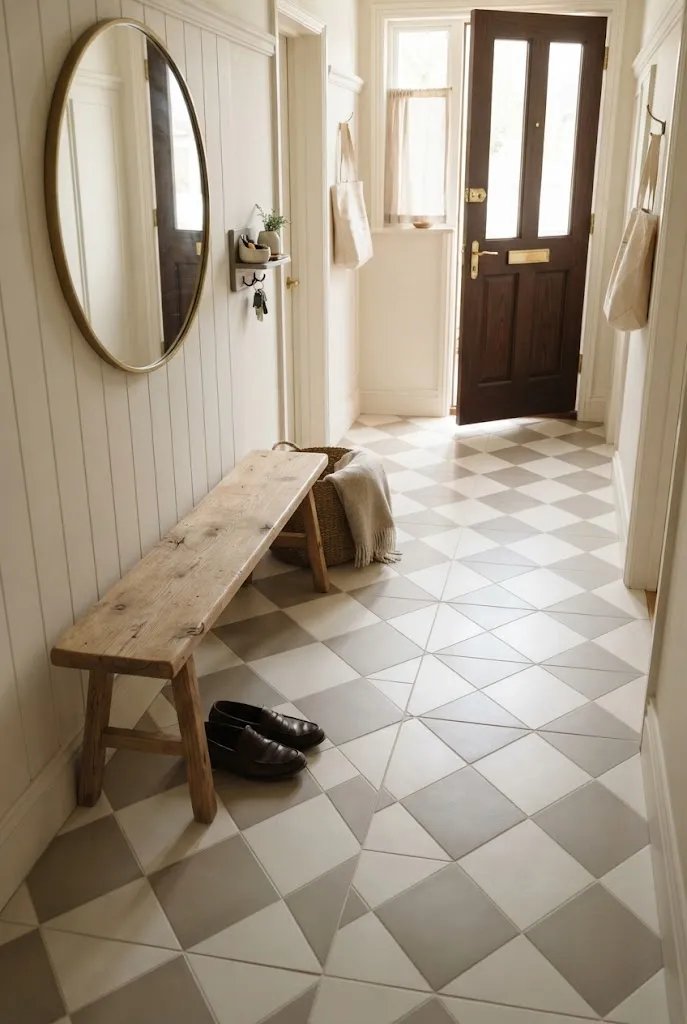
A checkerboard pattern gives a plain entry some energy and makes a small floor feel more designed. Black-and-white is the classic version, but softer pairings like cream and warm gray or terracotta and ivory feel more current in many homes.
| Option | Effect | Best Fit |
|---|---|---|
| Ceramic or stone tile | Durable, high-end look | Homeowners, renovations |
| Peel-and-stick vinyl tile | Removable, lower commitment | Rentals, quick updates |
| Checkerboard rug | No installation | Anyone, any floor |
True tile is a premium investment but holds up to heavy traffic. Vinyl peel-and-stick tiles are a faster alternative, though results vary with the subfloor and the product.
22. Color-Drench the Entire Foyer in One Shade
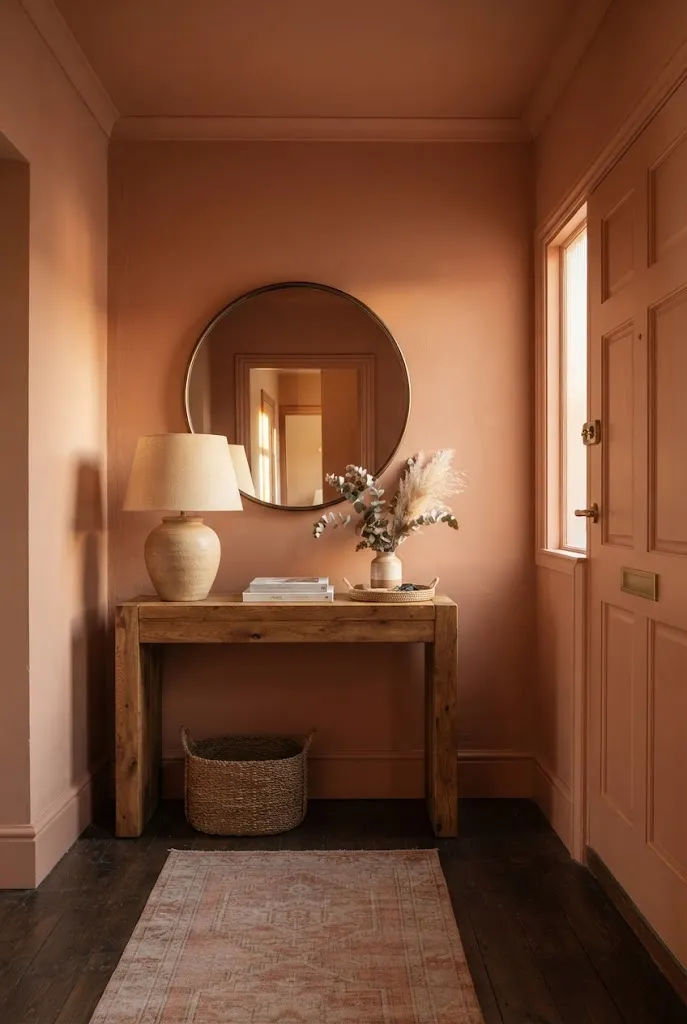
Painting the walls, trim, door, and sometimes even the ceiling in a single color makes a small or dim entry feel intentional rather than cramped. Without contrasting trim lines, the eye reads the space as one continuous surface, which softens the edges of the room.
Deep greens, rich blues, warm clay tones, and soft sage all work well in this style. Editor’s Note: Test the sample on the actual wall and look at it in morning, afternoon, and evening light. A color that looks calm at noon can read much heavier at night. Using a slightly different sheen on the trim than the walls adds subtle depth without breaking the single-color effect.
23. Style a Seasonal Vignette You Can Swap in Minutes
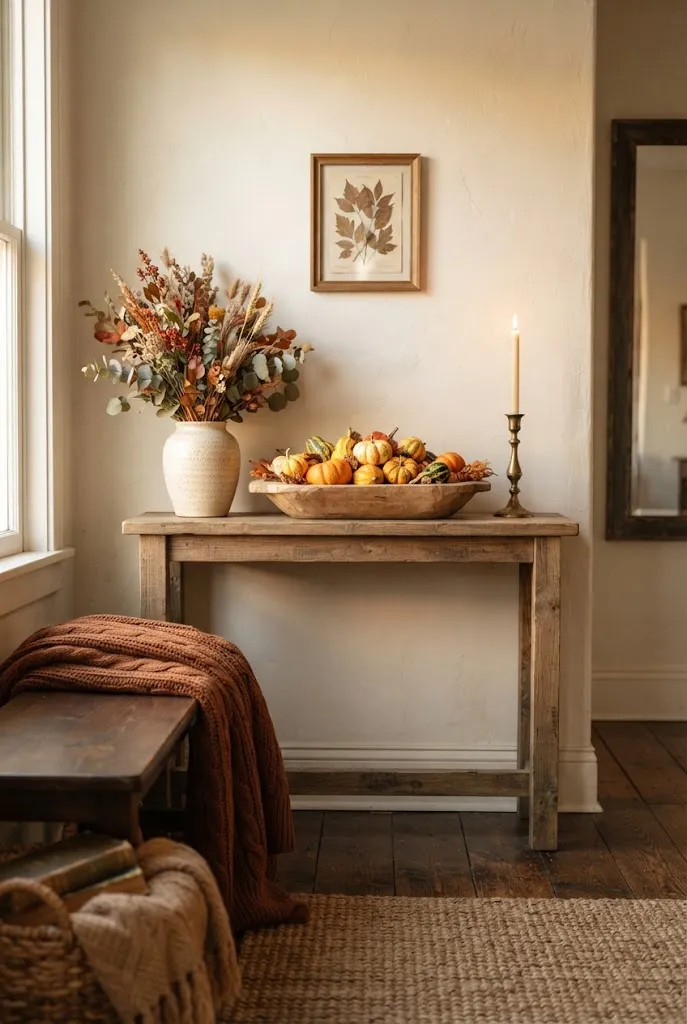
A permanent base, like a console, a mirror, and a lamp, can carry different seasonal accents throughout the year with very little effort.
- Fall: A shallow bowl of mini pumpkins, dried stems in a ceramic vase.
- Winter: A cluster of evergreen branches, a few candles in glass holders, a knit throw over the bench.
- Spring: Tulips or ranunculus in a simple vessel, lighter linens.
- Summer: A woven tray, a bowl of citrus, a jar of dried grasses.
Quick Tip: Store the seasonal items in one labeled bin so changing them takes minutes, not an afternoon.
24. Soften Sidelight Windows With Frosted Film or a Sheer Shade
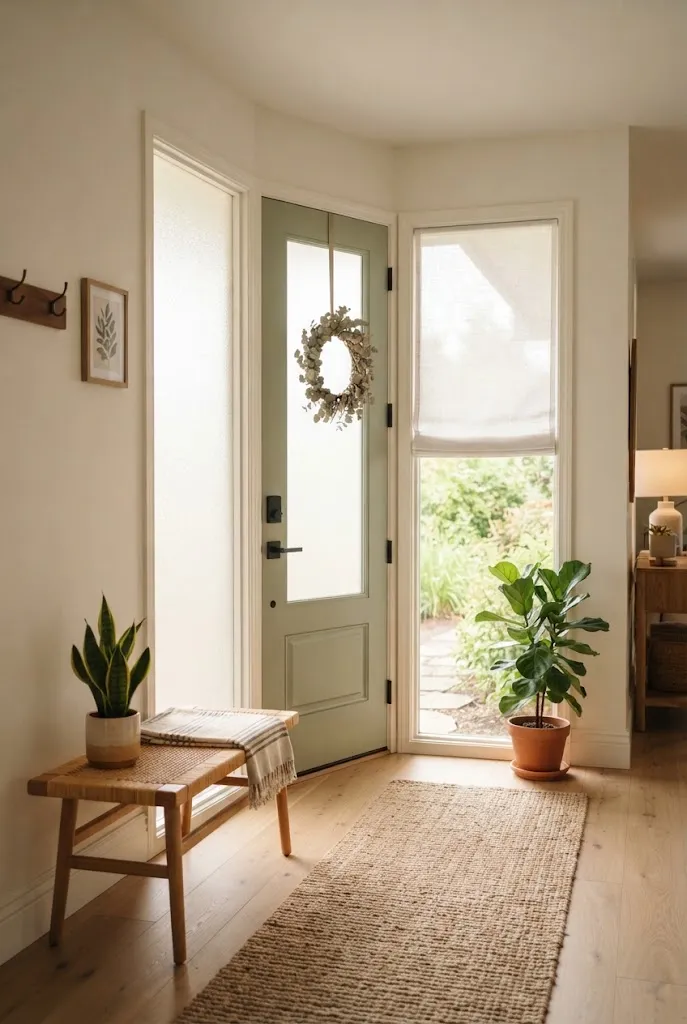
Narrow windows beside the front door let in good light but can also expose the entry to the street. Frosted window film is a removable fix that keeps the glow while blocking direct sightlines. A light-filtering cellular or sheer shade is another option that can be raised when you want the view.
Do: Measure the glass carefully before buying film, and clean the surface thoroughly before applying it.
Don’t: Choose a heavy, dark treatment that cancels out the very light you wanted from those windows.
25. Choose a Curved or Sculptural Console to Soften Straight Lines
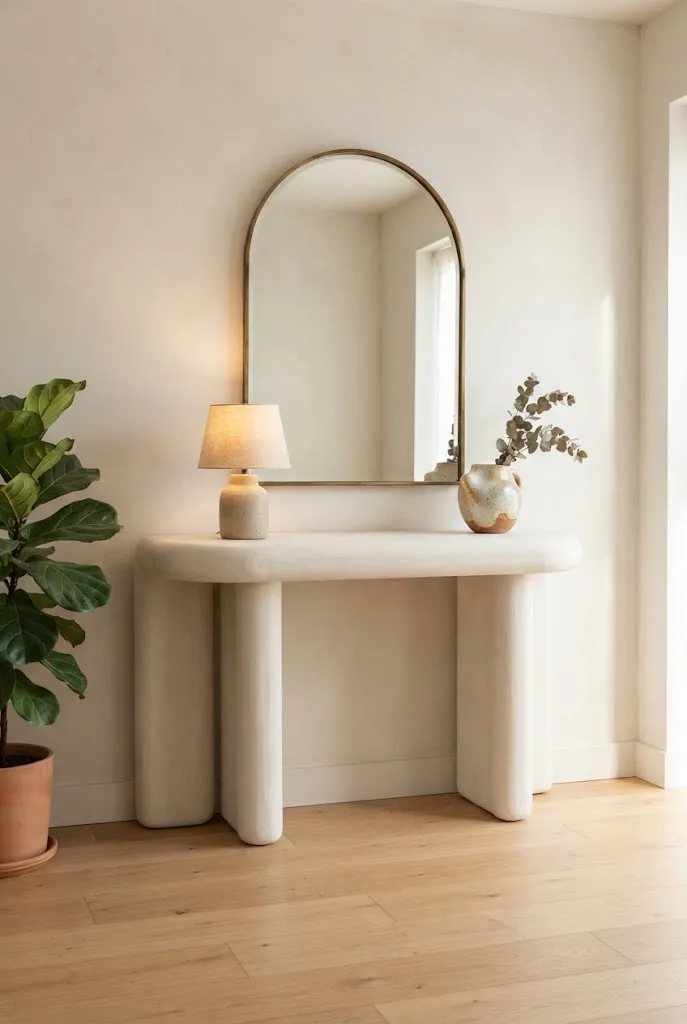
Entries are full of right angles: door frames, baseboards, corners. A console with rounded edges, a half-moon shape, or sculptural legs brings in some movement without adding visual weight. Rounded corners are also friendlier in a narrow walkway where people brush past with bags and groceries.
Wood, plaster-look finishes, and lightly aged metal all suit the style. Keep the styling simple on top of a piece like this, such as a lamp and one object, so the shape stays the focus instead of getting buried.
26. Tuck a Pair of Stools or Poufs Under the Console
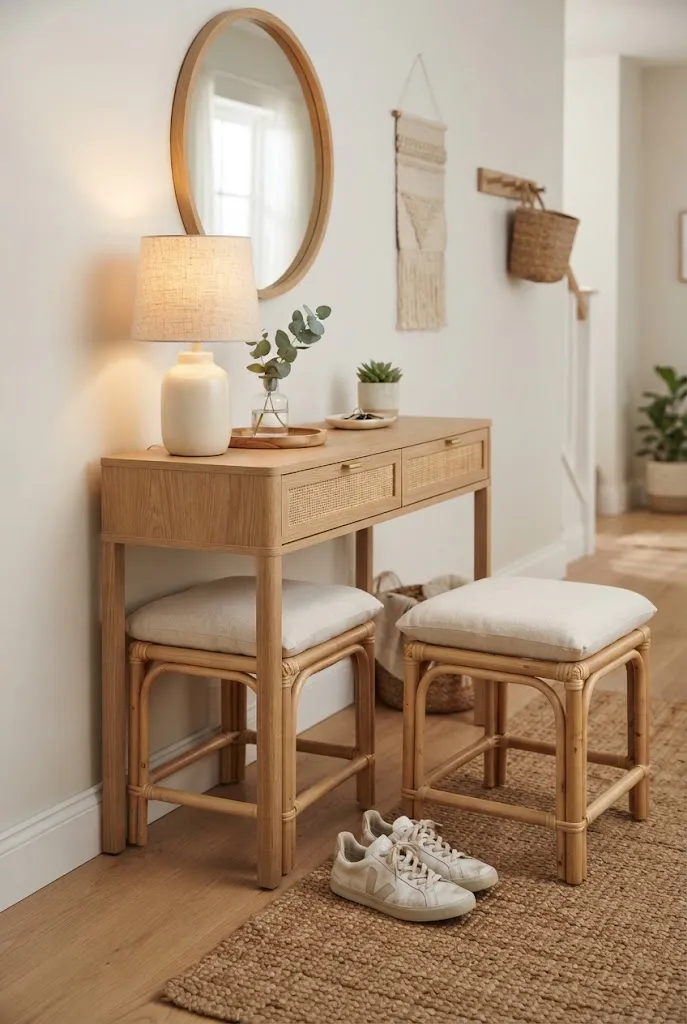
Two stools or poufs slid beneath a console give you flexible seating without a permanent bench. Pull them out when someone needs to tie their shoes, and push them back when the space needs to feel open.
Match the height of the stools to the console so they tuck in fully. Texture is where this idea shines: rattan, boucle, leather, or upholstered linen all look good against a wood or painted tabletop. A set of two feels balanced, and the idea suits shallow entries where a full bench would crowd the door.
27. Create a Landing Strip for Mail, Keys, and Chargers
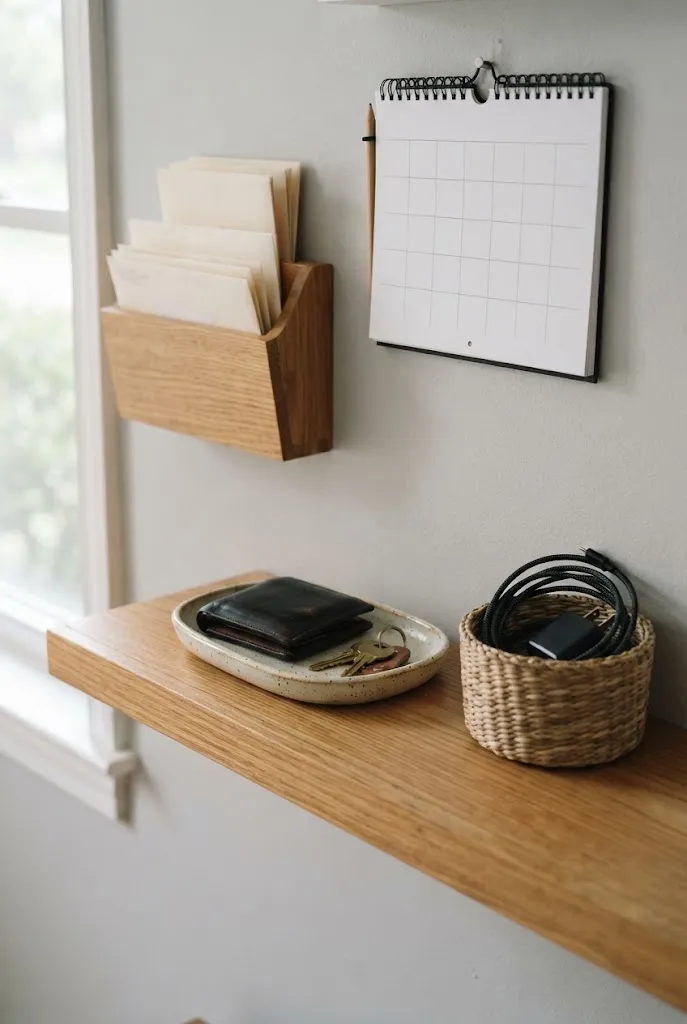
A functional drop spot reduces the clutter that tends to take over the entry.
- Start with a shallow tray or dish for keys and wallets.
- Add a wall-mounted or tabletop mail sorter so letters have a place to go.
- If there’s an outlet nearby, tuck a small charging station into a drawer or basket.
- Hang a small calendar or whiteboard for household reminders.
Keep the whole setup compact, and sort the mail at the end of each day. The idea works because it matches how people already behave when they walk in the door.
28. Add a Slatted Wood Accent Wall
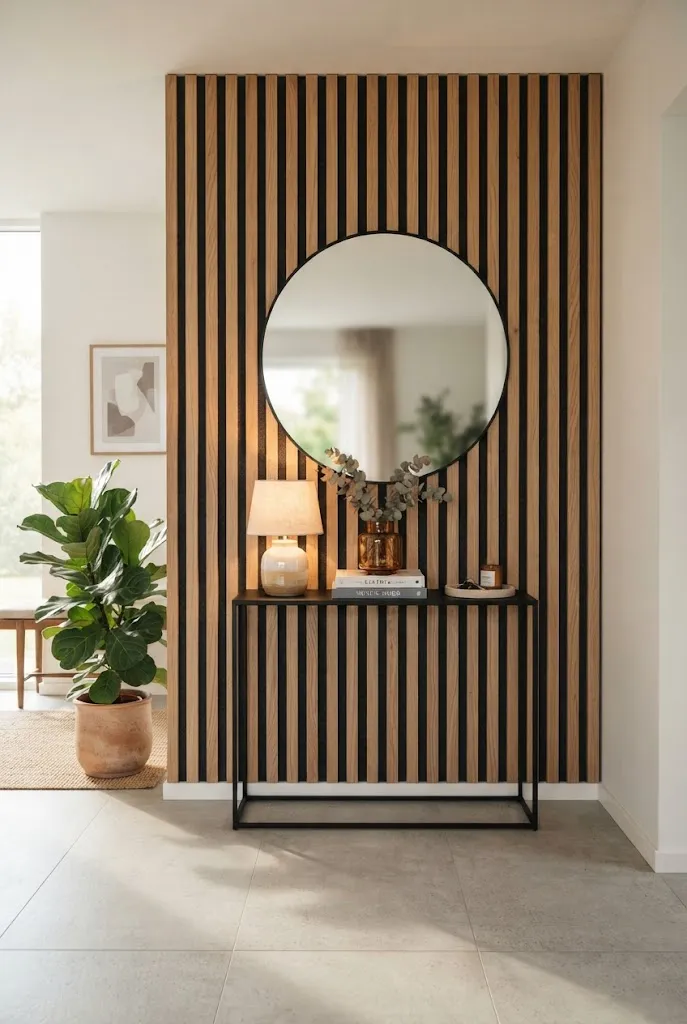
Vertical wood slats add warmth and texture, and they give a plain wall a tailored look. Ready-made slat panels, often mounted on a felt backing, are the easiest route, and individual slats installed by hand give you more control over spacing.
Keep the rest of the entry simple when you add a feature like this. A bench or a slim console with only a few styled objects is enough. Oak, walnut, and lighter ash tones each set a different mood, so choose one that matches the flooring or furniture in the adjacent rooms. Paint-and-stain finishes can also tie the slats into a darker color scheme.
Where to Start
You don’t have to tackle all 28. Pick the single biggest frustration in your entry and match it to one idea. If shoes are the problem, start with baskets or a bench. If the space feels dark, look at lighting, a mirror, or a lighter paint color. If it just feels bare, a console, a lamp, and a runner can fill most of the gap in an afternoon.
From there, add one change at a time, living with each before choosing the next. Entries tend to look best when they’re built up gradually, with every piece earning its spot.